

Peer review: Subjectively checking for objectivity
How does plant science work? Part III.


‘Indeed, it has been said that democracy is the worst form of Government except for all those other forms that have been tried from time to time.…’ (Winston Churchill)
Scientific peer review is the worst form of ensuring objectivity in science, except for all the other forms that have been tried from time to time. A little spark of objectivity sets science apart from all other ways to discover the truth about anything. Why should we subject that spark to subjective scrutiny? Let the data speak for themselves and get rid of those inquiring human minds with their biases, preconceptions, and orthodoxies. Isn’t it the whole point of science to reduce the subjective element?
Let’s back up a little bit. I tend to forget that I am not writing a book here and that most likely you have not read the previous chapters about how plant science works (part I and part II). Nor are you likely to remember them even if you have. What is this objectivity in science that I am blabbering about?
Objective is anything that can be confirmed or assumed independently of any human minds.[i] For example, it could be measured, counted, or imaged using a technical device, something as simple as a ruler. Controlled experiments (Fig. 2) result in measures that can be taken by anyone who can use the measuring instrument, and if everything works perfectly then the measurement is not affected in any way by the mind of the person doing the measuring. There are also objective observations that are not based on experiments, such as measuring radiation, gas concentrations in the air, changes in weather, identifying plant species, determining the number of trees in a hectare of forest, sequencing DNA, or describing the structure of a plant protein.
Objectivity is what makes it science; the problem is that human minds are required to do science, to design experiments and measurements, conduct them, analyze the data, write up the findings, and all the rest. Whenever human minds are involved, subjectivity reigns. That is not bad necessarily, but these minds have a history, a gender and ethnicity, a personality, they live in a culture, in organizations, and perhaps in a religious community. No need to tell you about human minds. I mean, who’s writing here and who’s reading?
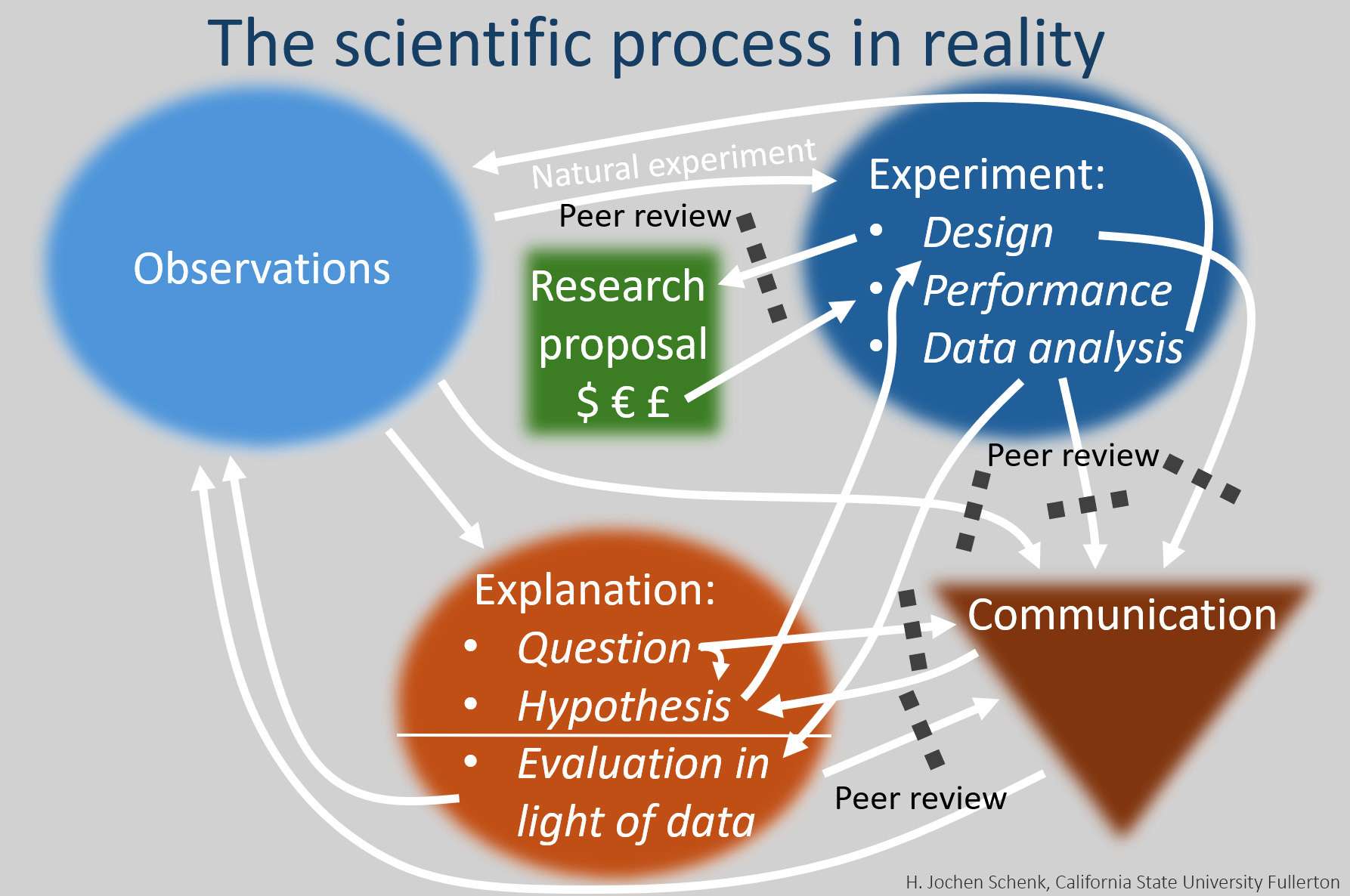
How scientific peer review works
Imagine, if you will, receiving a document in the mail that purports to contain some objective information about plants, supposedly obtained without the interference of human minds. This information comes in the shape of a controlled experiment and measurements taken to get objective answers to scientific questions about plants. The problem is that this document was written by human minds, the experiment was designed by them, the measurements were taken by them, the data analyzed, and then the human minds really got to work when interpreting the results.
You are kindly invited to ascertain the morsels of objectivity in this document and make sure that all the author’s inevitable subjectivity has not interfered with them. In other words, you are a peer reviewer. As you may have noticed, this is not a hypothetical example, because it happens to people all the time. These days, such invitations arrive via Email, which is also rapidly becoming a quaint form of communication; the digital age’s equivalent of the dial phone. But that’s what scientists use. You are given a deadline to submit the review and usually are promised to remain anonymous to the author, although there are variations in reviewer anonymity. More on that below.
Most people outside of science have no idea who these peer reviewers are, how one becomes a peer reviewer, how they are selected, and what the rewards are for the job. You have come to the right person to ask these questions because I am a peer reviewer, I have selected them in my role as journal editor, and I have been rewarded richly for my services, like all my peers, by knowing that I served my profession. There is, of course, no monetary reward, because there should be no financial interest involved in the peer review process. (Plus, journals would really hate to pay…)
Any plant scientist who publishes is likely also to act as peer reviewer, because we owe it to our profession to provide that service in return for the peer reviews that we are receiving for our own manuscripts. Most manuscripts get two to three peer reviews, so by simple calculation one would hope that every scientist conducts two to three times as many reviews as they submit papers for publications. Some scientists review a lot more; I know some who review about 50 per year, I usually limit myself to no more than 12 per year, and others hardly ever get or accept an invitation to do a peer review.
I have been a journal editor and have encountered the difficulty of finding suitable peer reviewers who have the required expertise for a manuscript’s subject and who are willing to take on the reviewing task. It has always been difficult to find peer reviewers, and it is getting much worse. There is a flood of new journals and submissions from around the world, as more and more countries get into the ‘game’ of academic publishing. A recent estimate of current scholarly publishing, not just science but all of academia, counts roughly 4.5 million peer-reviewed papers published per year, and — assuming an average acceptance rate of 30% — about 15 million total submissions received annually.[ii] A large amount of the growth in submissions is coming from China, which has turned from the scientific backwater that it used to be into a global force.
Fifteen million submissions every year require at least 30 million peer reviews. It is difficult to say how many publishing scientists there are worldwide, but recent estimates put that number at around eight million.[iii] If all these scientists wrote 3-4 peer reviews every year then the math would work, but many are never invited or always decline, so the actual burden on peer reviewers is much higher. These are not numbers specifically for plant science, but those numbers are likely to be similar. Too many submissions; not enough reviewers. You see, every publishing scientist is—or at least should be—a peer reviewer.
Scientific peer reviewers are essentially asked to do an objectivity check on the manuscript they are given, although it is never put that way exactly. Check the experimental design, methods, data analysis, and interpretations, the writing, literature cited, as well as the importance of the research for its field of science. Make suggestions for improving the manuscript and suggest to the editor if it is worth publishing or should be rejected. All in the service of maximum objectivity, because that is what science needs.
What could possibly go wrong? Bias in peer review
Every publishing scientist has a peer review horror story. No, correct that, several horror stories. These are about extraordinarily biased reviewers or those who had no expertise in the subject they were evaluating. I have such stories; everyone has them. Women, members of minorities in science, writers whose first language is not English, and junior scientists often view their horror stories of terrible reviews as signs of systematic bias, and they may be right, so more on that below.
Many fields in the plant sciences have dominant figures who set the tone and who have tons of former students and colleagues who follow their lead. I sometimes call these the orthodox priests of science, but that’s just between you and me. Please don’t tell anyone I said that. Anybody trying to publish a new finding or interpretation that goes against the grain of their orthodoxies will encounter peer reviewers ready to defend their orthodox views. Of course they do, because this is how human society has always worked. Science is a human enterprise.
Contrary what you might expect—and what I expected when I started out as a young plant scientist—scientific peers are largely not fond of new discoveries and insights, that is, not if they are made by others. It’s the competition after all, so who but a saintly person would cheer for the breakthrough discovery made by a competitor? I have known a few of those generous scientists, the late Herb Bormann[iv] comes to mind, but they are few and far between.
Yes, “extraordinary claims require extraordinary evidence”, as Carl Sagan famously said, but that quote can also be used as cudgel to keep your competition from publishing something you don’t like. “That’s an extraordinary claim,” a peer reviewer might write about something that he or she had never thought of before. Not adding in writing “…if this weren’t extraordinary then a genius like me would have thought about it already.”
My collaborators and I encountered this ‘extraordinary evidence’ cudgel from the orthodox priests of plant science when we attempted to publish our findings about nanobubbles in plants and when trying to get that research funded, which also must pass peer review. I will write about that experience in a future post, but I know that there is nothing unique about it. Read Hope Jahren’s book Lab Girl or Suzanne Simard’s Finding the Mother Tree if you want to hear about other examples in the popular literature about plant science. And yet, and yet…
I promised to write about peer review in plant science quite some time ago, because few people outside science know anything about it, but I have hesitated to approach that subject because I do not want to feed the anti-science frenzy that is going on these days, especially on the far right and occasionally the far left of the political spectrum. Of course, scientific peer review is beset by bias, how could it not be? But it exists because of that bias, as a process to combat subjectivity and bias in science, and it has been designed to work in the face of that bias to maximize objectivity in science.[v]
Apart from the orthodox priests of science, what other sources of bias are there? You might think that female scientists and minority groups might experience bias in peer review, and that is likely true in some cases, but recent analyses have shown that today overall there is no significant disadvantage based on gender across academia.[vi] Unfortunately, it likely remains a problem in specific male-dominated fields like forestry or engineering. Ethnicity, sexuality, or other attributes that unfortunately subject people to discrimination in public are not major issues for publishing, because those attributes are usually unknown to peer reviewers.
These findings are not specifically for plant science, but one of the studies I quoted in the last endnote was about the journal Functional Ecology, which publishes a lot of plant science. That study also documented significant bias in favor of established scientists, including those ‘orthodox priests of science’ (remember, don’t tell anyone I said that), who have it easier with their peer reviewers. Other recent studies have found the same thing.[vii] Are you shocked and surprised that reputation affects peer reviewers? Of course not. Again, that’s humanity at work. And it is not entirely undeserved. Inside or outside of science, experience and accomplishments matter to us. Is it unfair to the inexperienced and unaccomplished? It certainly feels that way.
Improving the peer review process
Ideally, each submission would get ten peer reviews. Extremely biased ones then could be weeded out and be recognized as such by an editor. Peer review of scientific proposals to the US National Science Foundation, the US National Institute of Health, and other such government institutions around the world often attempt to get that many reviews or at least as many as possible. Submissions to prestigious general science journals often also get many peer reviews. Unfortunately, this is not realistic for most journals who are very happy to get three reviews per submission, and usually no more than two.
Bias based on reputation can be weeded out by a process called double-blinded peer review. Here, the author does not know who the reviewer is, and the reviewer does not know who the author is, although they can sometimes guess. A recent study found that double-blind reviews led to a decline in the acceptance rates based on reputation, so the well-known scientists lost their advantage.[viii] Triple-blind review is even better. In that case, even the editor does not know the identity of the authors and is unaffected by reputation. Double-blind and—even more so—triple-blind peer reviews make it difficult for journals, because the staff must make sure to redact all that information and keep it hidden.
Another way to reduce reviewer bias is to ‘out them’ with the publication. Some journals publish the names of the reviewers together with the publication, so they cannot hide behind anonymity, which makes reviewers more careful in what they are writing. Some journals even publish the peer-reviews. While this may sound like a good idea, writing peer reviews is work without pay, and it is a more demanding job if you know that your writing will be seen by the public. Many peer-reviewers, including me, are not willing to review at all if their reviews are made public. It is just too much work for no reward whatsoever.
Could peer review by AI reduce bias? Do we really have to ask? Generative AI is trained on online and published content, so it reflects all the human bias in the world. Grok AI shows that it can be just as bigoted and racist as the owner of the company that makes it. Other AI tools may be better, but it is absurd to think that human-made AI would be bias-free.
Does scientific peer review work?
I hate getting my manuscripts and grant proposal reviewed, I really do. After reading the reviews, no matter what they say, I need a walk around the block and a day or two to calm down. And while I walk, I mutter adjective-laden comments about these unknown peer reviewers; that’s the first thanks they get from me for their service to the profession. So much work goes into doing research and writing a manuscript or proposal, so much depends on success, that it is really hard to get reviewed by people who just put a few hours into the task and then move on with their lives.
Some scientists never get past that stage. They continue to be furious about unfavorable reviews and write responses to the editor that say so. I have seen scientists complain about peer reviewers plenty of times on social media, even here on Substack. These scientists are just like actors, writers, musicians, or painters who cannot stomach reviews of their work. And unlike the members of these creative professions, scientists cannot ignore the reviews. They must respond if they wish to resubmit their paper or proposal and make changes.
Every time, I come around to finding peer reviews very helpful for improving my manuscripts and proposals. Even the most biased orthodox priest of science has something to offer that should be addressed to make a change, so that other people like them won’t have that same reaction as they did. I hate the process and am a big fan of it. Most scientists probably feel that way. Peer review really works as well as it realistically can, despite all its flaws.
The research done on peer review suggests that double-blind or triple-blind review is the best way to improve the process and to reduce bias. Personally, I do not like it. As an author, I’d rather have reviewers know who I am and what I have done in the past. Yes, I am a senior researcher who could benefit potentially from reputation, but I am also known in my field as that ‘nanobubble guy’ who keeps standing up against the orthodox priests of my field of plant science. I say, let them know it’s me and that I keep adding to that research. Both as an author and a reviewer, I think that more information is always better than less information.
I have little scientific research on my side when I propose that rather than going to double- or triple-blind review what we need is better education of peer reviewers and editors to reduce bias. There is essentially no training for how to conduct peer reviews, we scientists learn by reading reviews and sometimes by seeing what more experienced colleagues do for their reviews. There should be formal training for the job.
Plus, reviewers need a better reward system. No financial reward, but a recognition from university employers that peer review is part of their job and requires paid time. Good systems to document your reviews, so you can show that evidence to employers and so that editors can see who is reviewing and who isn’t. A lot of scientists get overlooked and are never invited to review. If editors could find those people it would make publishing easier and train more reviewers from more diverse backgrounds. Diversity matters always because it broadens perspectives and reduces bias.
In conclusion: Yes, peer review! Subjective evaluation is all we have to ensure maximum objectivity. It’s a good thing and could get better, of course. I realize that there was hardly anything specific about plant science in this piece, because there are no plant-specific studies of scientific peer review. But this is my experience and perspective as a plant scientist, author, reviewer, and editor, so perhaps scientists from other fields would tell a different story.
I would love to hear your thoughts and questions about peer review in plant biology, so please hit the button and fire away.
If you appreciate my work and want to support it please consider a small one-time donation via the ‘Buy me a Book’ button below. I read a lot of books for this Substack, and some independent bookstore near me will benefit from your donation. Thank you!
MUSICAL CODA
“But I would not be convicted by a jury of my peers…”
[i] Solomon, R. C. 2005. Subjectivity. Page 900 in T. Honderich, editor. Oxford Companion to Philosophy. Oxford University Press, Oxford, UK.
[ii] Anderson, K. 2025, Nov 4. Manuscript submissions are up! That’s good, right? The Scholarly Kitchen (Society for Scholarly Publishing blog). https://scholarlykitchen.sspnet.org/2025/11/04/manuscript-submissions-are-up-thats-good-right/
[iii] Ioannidis, J.P.A., Baas, J., Klavans, R. & Boyack, K.W. 2019. A standardized citation metrics author database annotated for scientific field. PLoS Biology 17:e3000384. https://doi.org/10.1371/journal.pbio.3000384
Updated in: Ioannidis, J.P.A. et al. 2020. Updated science-wide author databases of standardized citation indicators. PLoS Biology 18::e3000918. https://doi.org/10.1371/journal.pbio.3000918
[iv] Likens, G. E. 2013. Resolution of respect: F. Herbert Bormann 1922–2012. The Bulletin of the Ecological Society of America 94:304-308.
[v] Drozdz, J. A., and M. R. Ladomery. 2024. The peer review process: Past, present, and future. British Journal of Biomedical Science 81:12054.
[vi] Squazzoni, F., G. Bravo, M. Farjam, A. Marusic, B. Mehmani, M. Willis, A. Birukou, P. Dondio, and F. Grimaldo. 2021. Peer review and gender bias: A study on 145 scholarly journals. Science Advances 7:eabd0299.
Fox, C. W., J. Meyer, and E. Aimé. 2023. Double-blind peer review affects reviewer ratings and editor decisions at an ecology journal. Functional Ecology 37:1144-1157.
[vii] Drozdz, J. A. et al. 2024. Cited above.
Huber, J., S. Inoua, R. Kerschbamer, C. König-Kersting, S. Palan, and V. L. Smith. 2022. Nobel and novice: Author prominence affects peer review. Proceedings of the National Academy of Sciences 119:e2205779119.
[viii] Fox, C. W. et al. 2023. Cited above.
This article was pia-reviewed ✅️
Three thoughts. First, I totally agree with the idea of training for reviewers. The challenge is that this demands reviewers take the time to do so and some will balk at that. In the geosciences we get some review instructions with the manuscript that provide guidelines. I do wonder how many reviewers read them carefully. Second, as both a recipient and provider of reviews I have often wished for the opportunity to provide or receive feedback. As an author I have found some reviews are a blessing and others best ignored. Feedback to reviewers from both authors and editors would also go a long way to training reviewers. Sometimes I would really like to more explicitly thank a reviewer. for their insights. I suspect those reviewers who would object to getting feedback might self-select out which might not be all bad. I sometimes think I have provided a particularly helpful review, but how am I to know? Third and perhaps more philosophic - I would argue there is a continuum between objectivity and subjectivity that it would be helpful for all to be reminded of. Science can't be purely objective, but it can be more more objective than alternatives, which is useful and part of the tremendous success it has had in understanding the world around us. Thanks so much for your post. It is especially nice to hear it from an editor's perspective.