

Wallflowers
The individuality and invisibility of plants

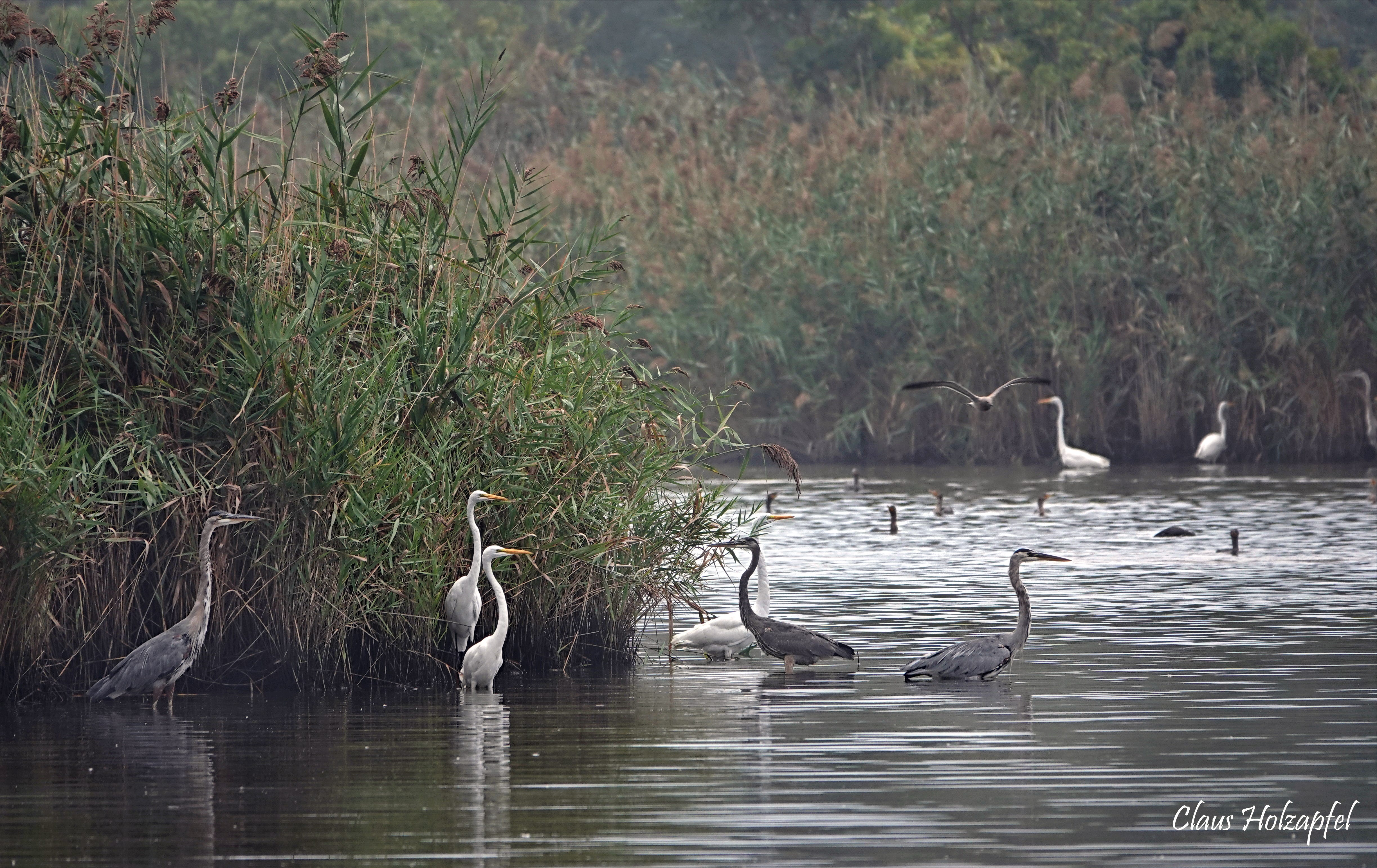
The photo at the top shows, well what does it show? Some birds standing in water, you may say. Look again. What else do you see? There appear to be at least two bird species, white ones, great egrets, and darker ones, great blue herons. Also, some ducks on the water and a gull in flight, if you look closely. Anything else? Well, yes, there are some plants, mostly tall reeds (Phragmites australis).
It is a sure bet that you first noticed the birds and the water before the plants, even though the plants take up a much larger space of the image. Why is that? Selective and preferential attention to animals over plants is extremely common and has been called ‘plant blindness’[i]. It is not just animals. You probably noticed the water before the plants. I did! But, again, why?
Plant awareness disparity
There has been a lot of hand-wringing over plant blindness and plenty of blame attributed to society, schools, and even universities for doing such a poor job in stimulating interest in plants. Plants are so important for keeping our planet alive; why do so many people barely notice them? Inevitably, the term plant blindness has come in for criticism because it uses a word for a disability in a negative connotation. Never mind that ‘blind’ is used in so many ways other than to describe visual impairment, as in ‘love is blind’, ‘turn a blind eye’, ‘blind date’, or the Bruce Springsteen song Blinded by the light. Blind to all these uses of the word ‘blind’, someone proposed to call it plant awareness disparity (PAD) instead.[ii]
It is easy to make fun of turning the concept of plant blindness into yet another acronym, but I grudgingly admit that it is a better description of what is happening. If you noticed the birds and the water in Figure 1 first, you weren’t actually blind to the plants. Your attention was elsewhere. In fact, it is the attention that goes to birds and water first, not the awareness. I am sure that anyone looking at that picture is aware of the plants, just not paying much attention. Plants are the wallflowers of the natural world.
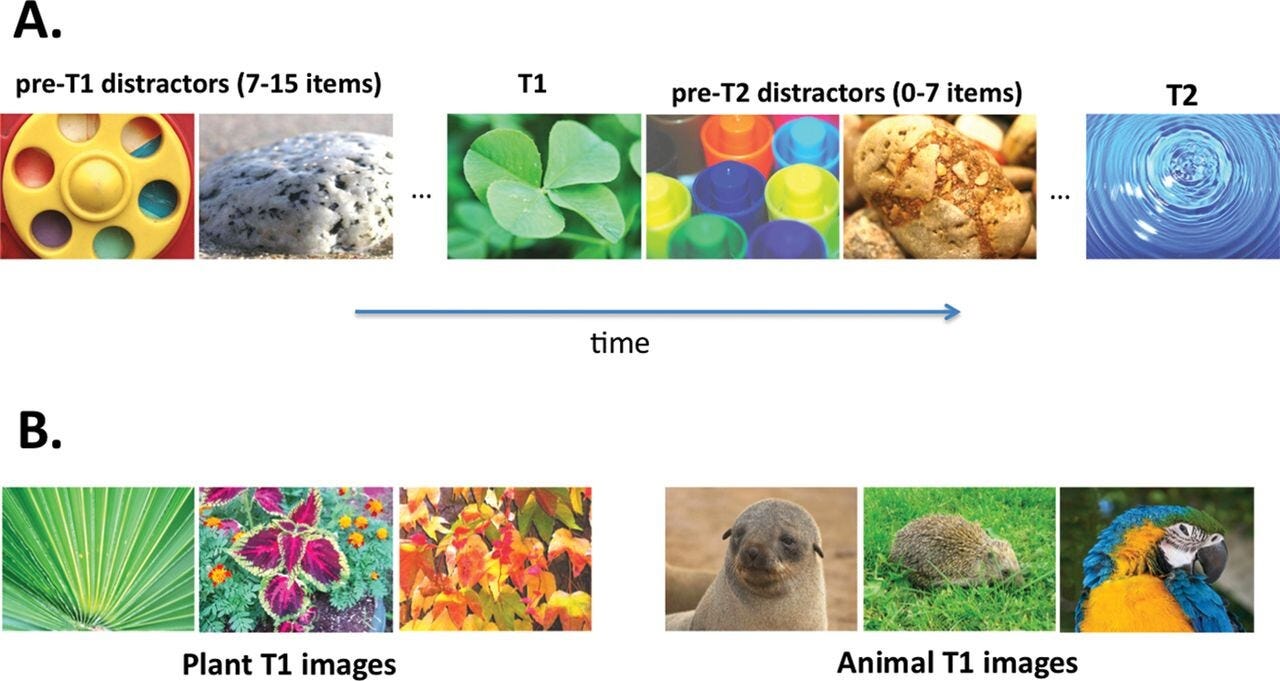
Some years ago, a team of researchers at North Dakota State University came up with a great idea for testing if people really pay more attention to animals than to plants.[iii] They showed study participants random images in a rapid sequence, with some sequences including photos of animals, plants, or water. Each image was visible only for 32 milliseconds, so barely registered in the brain. Participants were about 30% more likely to correctly report that an animal was in the sequence than that there was a plant.
There are many other studies about plant vs. animal awareness, but this attention study stands out because it addresses human attention to plants, independently of education or personal interests, experience, or culture. For some reason, we humans pay more attention to animals than to plants. Take another look at the photo in Figure 1. Doesn’t it seem clear that there is a reason for this selective attention? Try to identify and count the birds and the plants. The birds are easy to count, except for the ducks, which are a bit difficult to spot. But it is impossible to count the plants, not just because there are too many, but because it is impossible to tell what counts as ‘a plant’. They are difficult to spot as individuals.
Then check out Figure 2 to see examples for images of plants and animals shown in the attention study. Isn’t it much easier to recognize the animals immediately than the plants? I bet the results would have been different if all the plant images had been of whole trees or annuals that are more easily seen as individuals.
Individuality of plants
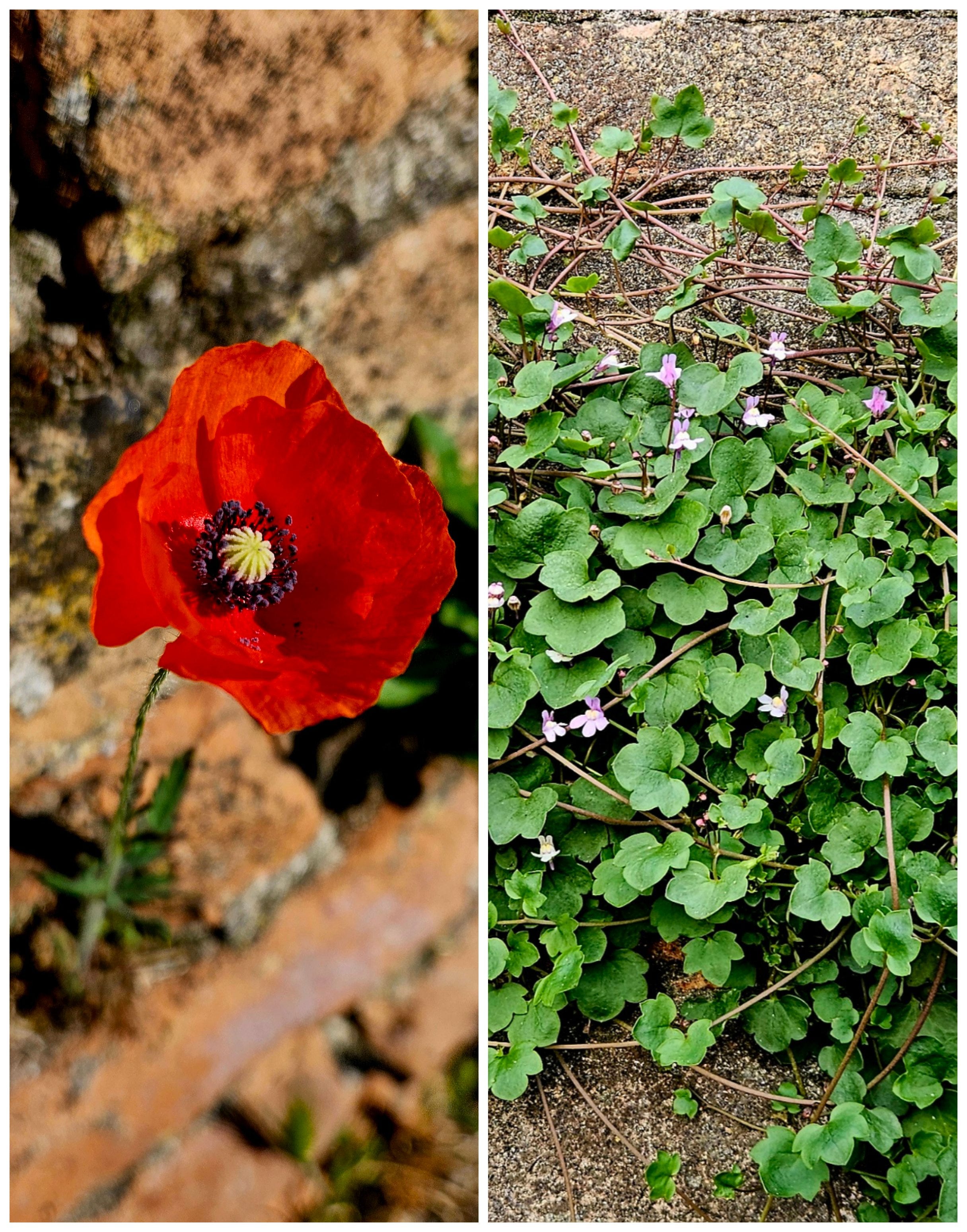
Some individual plants are easy to identify, such as annuals and trees, but many plants spread sideways with many stems, and it is often difficult to distinguish individuals (Figure 3). Clonal plants like the reeds in Figure 1 or the toadflax in Figure 3 spread by horizontal stems or roots, and a large patch of those plants may just be one connected individual. Or the clonal plants may have fragmented into separate units that are separate individuals but genetically all the same. My point is that it is quite often difficult to make out individual plants in dense vegetation.
This difficulty with plant individuality stems from their growth as modular organisms. All plants grow by adding modules consisting of stems, leaves, and sometimes flowers or other reproductive structures. Check out the toadflax plant in Figure 3 for a good example of this modularity. In contrast, almost all animals are unitary organisms that grow by increasing their body size, not by adding modules.[iv] All single-celled organisms are also unitary, although many bacteria from chains, threads, or aggregates that appear to be multicellular. Apart from animals and single-celled organisms, most other organisms are modular, including plants, algae, fungi, and colonial marine invertebrates, with a lot of diversity in the types of modular growth[v]. Sponges are an interesting group, because they include both modular and unitary species.
My point is that our attention to plants is impaired not primarily by a lack of cultural awareness or education, but because we often do not perceive them as individuals and therefore also do not register them as being alive by our human standards. From our animal perspective, it would also seem that something is barely alive if you can snip off or eat parts without killing the organism. It is an essential aspect of modular organisms that killing or harming some modules does not usually kill the entire organism. Plants are so strange to our animal mind!
Inattention to plants may be the norm for city dwellers, a very large part of humanity today, but there are many situations in which humans pay attention to plants. The scientist and author Jared Diamond studied relationships with plants in hunter gatherer societies in tropical forests. Hunter-gatherers of course pay a lot of attention to plants, searching for food, plant materials, and potential dangers. In a talk, Diamond mentioned asking hunter-gatherers in New Guinea what they were most afraid of when going into the forest and being surprised when the answer was not a dangerous animal but that a tree or big branch might fall on them. That is a realistic concern for someone who lives all their life in a forest, and of course they are paying attention to the trees! You, too, pay attention to plants when you are hiking a mountain trail to go around bushes and trees and not stumble on a root.
Turning inattention into attention
For city dwellers, however, inattention to plants is almost the norm, and it is paired by the common belief that plants don’t do anything and are boring. Imagine yourself for a second in the hypothetical scenario of being a writer who writes about plants, let’s say for the sake of the argument a Substack called The Plant Connection or Plant & Zo, the name of Femke de Jong’s great plant science newsletter. This human inattention to and unawareness of plants and the notion that they don’t do anything create problems for people who write about plants. It is also a challenge for anyone who teaches about plants.
One way some authors deal with that challenge is by imbuing plants with human and animal attributes, referring to plants as mothers or attributing to them feelings, intentions, and consciousness. That works great as an attention grabber. Authors who humanize plants in their books are often hugely popular, including Peter Wohlleben, Suzanne Simard, Monica Gagliano, and Stefano Mancuso. The last three of these are plant scientists, but what sets them apart from most other plant scientists is that they have books to sell to a general readership. Are they successful authors because they happen to humanize plants or do they humanize plants to be successful authors? Who knows, maybe both?
If one chooses to let a plant be a plant and not turn it into some sort of green animal[vi], what is to be done in the face of general inattention to raise awareness of plants and tell people about how important and fascinating they are? Well, you are looking at it, this Substack exists for exactly that mission and purpose. There are many book authors who write engagingly about plants without turning them into green animals, including Harriet Rix (The Genius of Trees), Steven Vogel (The Life of a Leaf), Jonathan Silvertown (An Orchard Invisible), Robin Wall Kimmerer (Gathering Moss), David Attenborough (The Private Life of Plants), and many others.
I do not need to convince you that plants are interesting because you read and hopefully subscribe to The Plant Connection and you read all to the end of this post. With many non-readers out there, we plant writers and plant teachers are up against human nature, the inattention to plants that afflicts most city dwellers. When I tried to sell my own plant book the most encouraging response I received from a literary agent was “I already have a plant book to sell.” Like there couldn’t possibly be more than one book on a subject that does not get much attention.
Don’t get me wrong: I like the challenge, and I will keep writing. Plants and our connections with them are endlessly fascinating. Especially the wallflowers!
If you appreciate my work and want to support it please consider a small one-time donation via the ‘Buy me a Book’ button below. I read a lot of books for this Substack, and some independent bookstore near me will benefit from your donation. Thank you!
MUSICAL CODA
[i] Wandersee, J. H., and E. E. Schussler. 1999. Preventing plant blindness. American Biology Teacher 61:82,84,86.
Wandersee, J. H., and E. E. Schussler. 2001. Toward a theory of plant blindness. Plant Science Bulletin 47:2-9.
[ii] Parsley, K. M. 2020. Plant awareness disparity: A case for renaming plant blindness. Plants, People, Planet 2:598-601.
[iii] Balas, B., J. L. Momsen, and E. A. Holt. 2014. Attention “blinks” differently for plants and animals. CBE—Life Sciences Education 13:437-443.
[iv] The distinction between modular and unitary organisms was first made by the British biologist John Harper. For example, in: Harper, J. L. 1977. Population biology of plants. Academic Press, London.
[v] Zhukova, L. A., and A. A. Notov. 2026. Polyvariance of ontogeny and structural evolution of modular organisms. Paleontological Journal 59:1291-1300.
[vi] The Italian biologist and science journalist Marco Ferrari recently published a book entitled Le piante non sono animali verdi (Plants are not green animals). I can’t for that to be translated into English.
The "it's hard to distinguish between individual plants" bit is interesting. I wonder if they'd chosen photos of individual flowers--a sunflower, a tulip, a daisy--if people would've had an easier time. That said, there's also probably also something to the fact that my brain thinks it can "recognize," in some way, an egret's inner life. (My brain is wrong, but it does it every time.) It doesn't think it can imagine the inner life of an oak tree.
Thanks for the shout out.
I think also that there is an accumalitive effect. In that when people are less aware of plants, or the dangers they might cause, they tent to be less interesting in them. Which in turn results in making them less often a topic to be discussed in an educational setting or other situations. This in turn lets ths next generation believe plants are boring or otherwise irrelevant because hey they would have learned about them more is it was needed. And so the cycle continues untill it is broken.
The good thing is there is an appitite for more indepth plant stories and knowledge, even if some people don't yet know that is where they are searching for.