

We hold these truths...
The revolution that toppled the plant kingdom

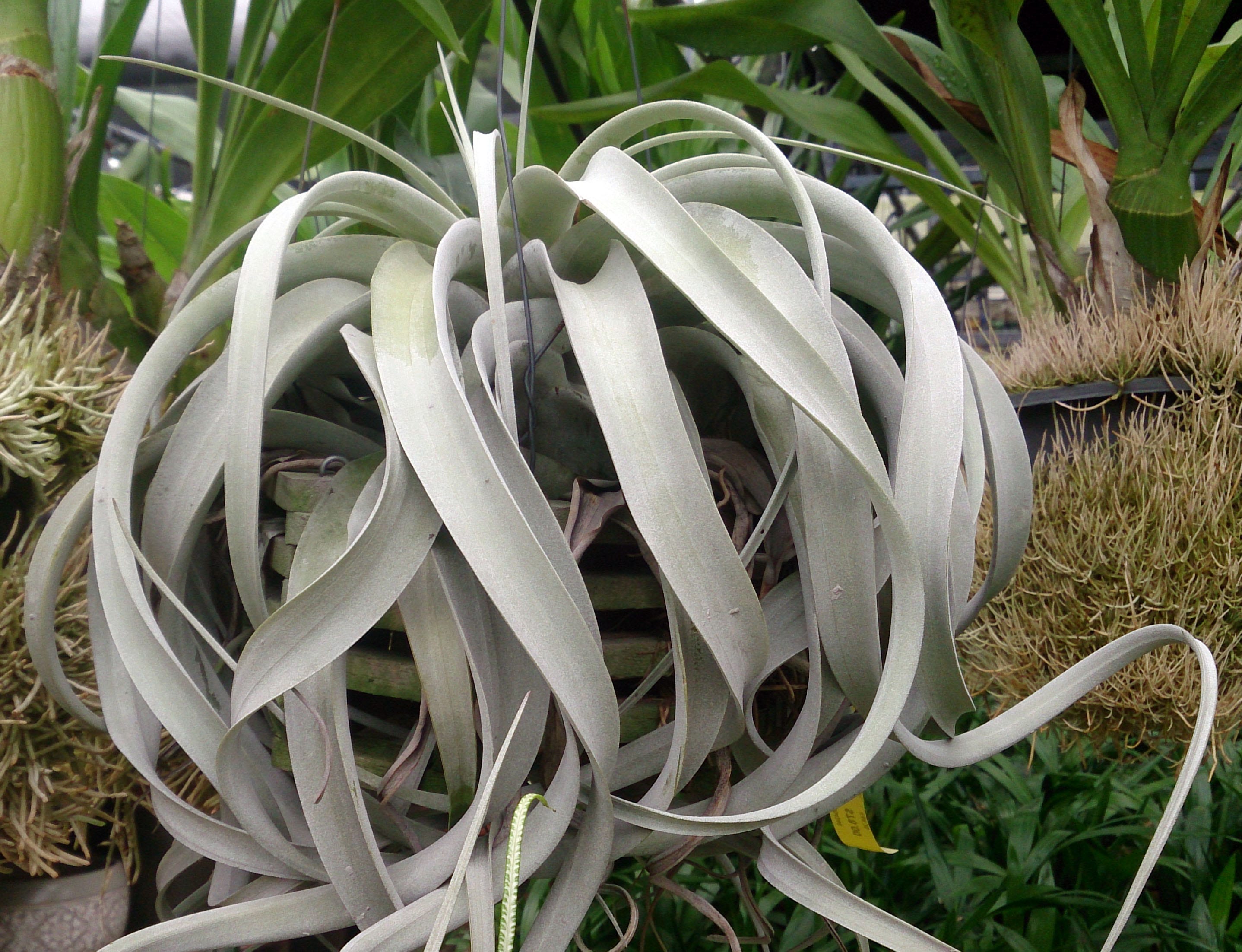
The lion is the king of the jungle, but who is the king of the plants? Perhaps the King Air Plant (Tillandsia xerographica)? Bad news for both kings: The lion may be the king of the savanna, but certainly not the jungle. They don’t even sleep in the jungle, the mighty jungle, and certainly not tonight. And the king of plants was toppled when the plant kingdom was overthrown together with the kingdoms of animals, fungi, protists, and bacteria, many decades ago.
Yet, the plant kingdom lives on in the popular imagination. Science communicators like Sir David Attenborough and Neil deGrasse Tyson keep referring to it, probably as a shorthand to refer to all plants, and I am sometimes tempted to do the same. The term “plant kingdom” has been used online at least 673,000 times since 2020, long after science abandoned the concept. So, what happened to the plant kingdom? Why was it toppled? Is the Royal family okay? Well, that last question may not be relevant. But let’s take a look at the other questions.
In biology, the kingdom is a taxonomic category to encompass large numbers of organisms that have a lot of characteristics in common and therefore traditionally were thought to be related. The category still exists, but it has lost its original scientific meaning. If you look up the King Air Plant on Wikipedia, you will get a list that looks like this (abbreviated):
Kingdom: Plantae, Order: Poales, Family: Bromeliaceae, Genus: Tillandsia, Subgenus: Tillandsia subg. Tillandsia, Species: T. xerographica. (Note that in biology, the genus name, here Tillandsia, and the species epithet, here xerographica, are both printed in italics.). So, the kingdom of plants, Plantae, still exists as a taxonomic concept.
From two to five kingdoms of life
The idea of kingdoms of life goes back to Aristotle, who divided organisms into Plants and Animals, and this division remained even into the 18th Century when Carl Linnaeus invented the modern system of scientific classification of organisms. The discovery of bacteria later added a third kingdom, and the biologist Robert H. Whittaker proposed in 1969 to add two more kingdoms, Fungi and Protists, making five.[i] The protist kingdom was a grab-bag from the start, including all organisms that clearly did not belong into any of the other four, and Whittaker placed it below plants, animals, and fungi in his tree of life (Figure 2).
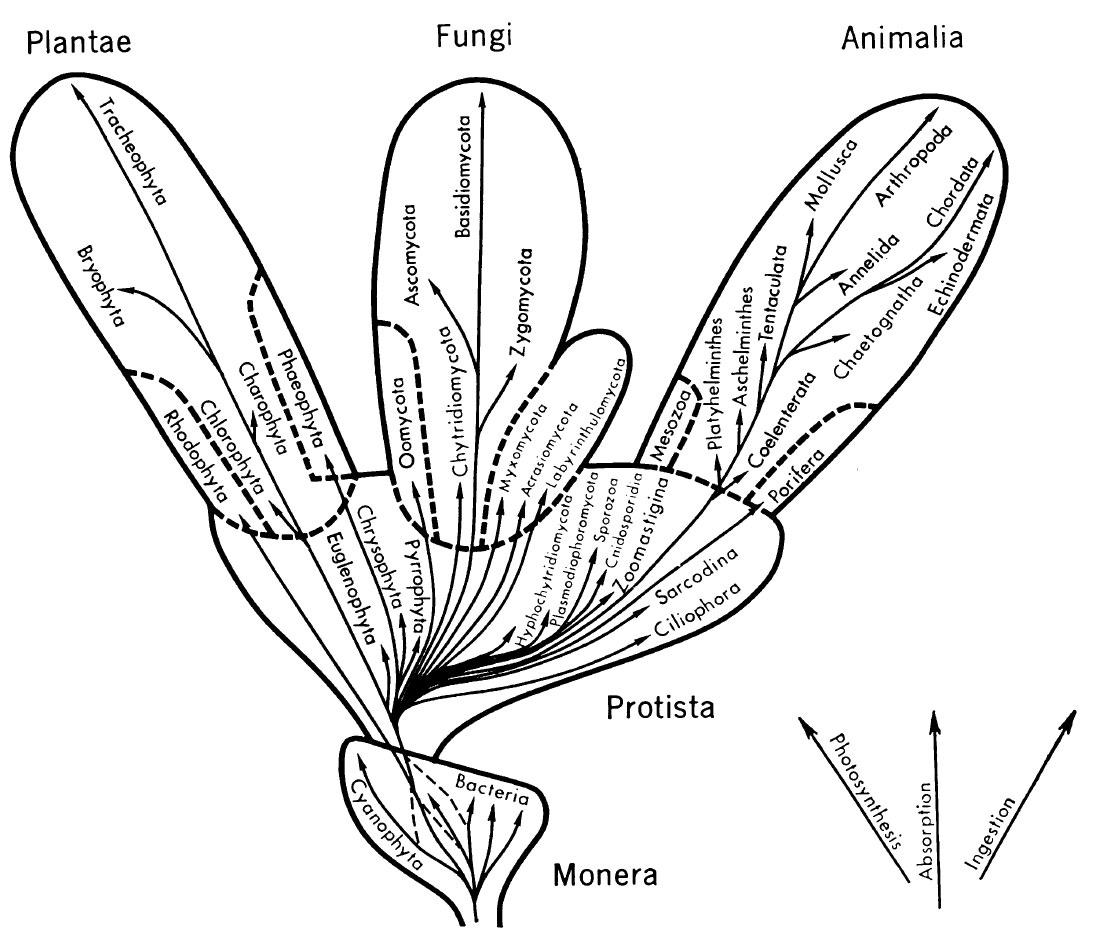
Whittaker’s tree of life is important because it is a view of life that is still widely shared in the public imagination. See how some groups appear to be more highly evolved than others in Figure 2? Among animals, the Arthropods (including insects and arachnids) and Chordata (vertebrates) seem to be at the top of the tree, the fungi on top are the Basidiomycetes, which include edible mushrooms like button mushrooms, porcini and chanterelles, and among plants the Tracheophytes (vascular plants) are on top. Protists and bacteria (here referred to as Monera) are at the bottom.
What is wrong with this picture? Am I some sort of revolutionary who is trying to convince my readers to topple the natural order? Aren’t we humans more highly evolved than any other species? I hope that nobody who reads this agrees with that last statement, but don’t you agree that it is a common sentiment? Much like many would consider an apple tree to be more highly evolved than a moss or a green algae.
The thing is that all living organisms are exactly as highly evolved as any others. We organisms all share the same ancestor and had exactly the same time to reach our current ‘pinnacle’ of evolution. Nobody got stuck along the way and stopped evolving except for species that went extinct. Many organisms living today kept ancient inventions of evolution because they worked. Spores work great for reproduction of green algae, mosses, and ferns, so these plants kept them while others evolved seeds. Most algae stick with the aquatic lifestyle, because it works, not because they are less evolved than land plants.
All living organisms had the same time to evolve, so shouldn’t we hold these truths to be self-evident that all organisms were created equal, and that nobody is on top or at the bottom? I could not resist mangling that famous quote, but this truth is even more than self-evident.[ii] It is supported by a massive amount of objective scientific evidence that supports the theory of evolution. Although Whittaker’s tree of life lives on in the public imagination, it was abandoned by science a long time ago.
The toppling of the kingdoms
The first blow to this hierarchical tree was delivered in the seventies by the discovery of archaea, single-celled prokaryotes that are not bacteria.[iii] This lead to the proposal that there are not five kingdoms of life but three ‘domains’, Archaea, Bacteria, and Eukaryotes, the latter of which include organisms with a cell nucleus and cell organelles, such as plants, animals, and fungi. Then phylogenetics and later phylogenomics took over, based on rapidly improving methods to analyze first proteins and then RNA and DNA of large numbers of organisms. It became possible to study the genetic makeup of almost any organism, including extinct ones if specimens were still available, and including bacteria and archaea that often do not even have scientific names.
It would go too far to attempt here an explanation of how these genetic data are generated and analyzed to determine how organisms are related to each other. Let’s stick with our subject and see what effect this scientific development had on the former plant kingdom. Today’s trees of life no longer have a top and a bottom; they show that everything is at the same level, and organisms are grouped by genetic similarity.[iv]
These trees today do not show time like a family tree would, because today’s mosses did not evolve any earlier than today’s apple trees. So, mosses and apple trees are both at the ‘top’. But you can see that mosses and apple trees share a common ancestor, indicated by the branches of mosses and apple trees meeting. That common ancestor lived a long time ago, but the phylogenetic tree does not say anything about when that was. There are ways to estimate how long ago a common ancestor lived, but the trees do not reflect that time in any way.
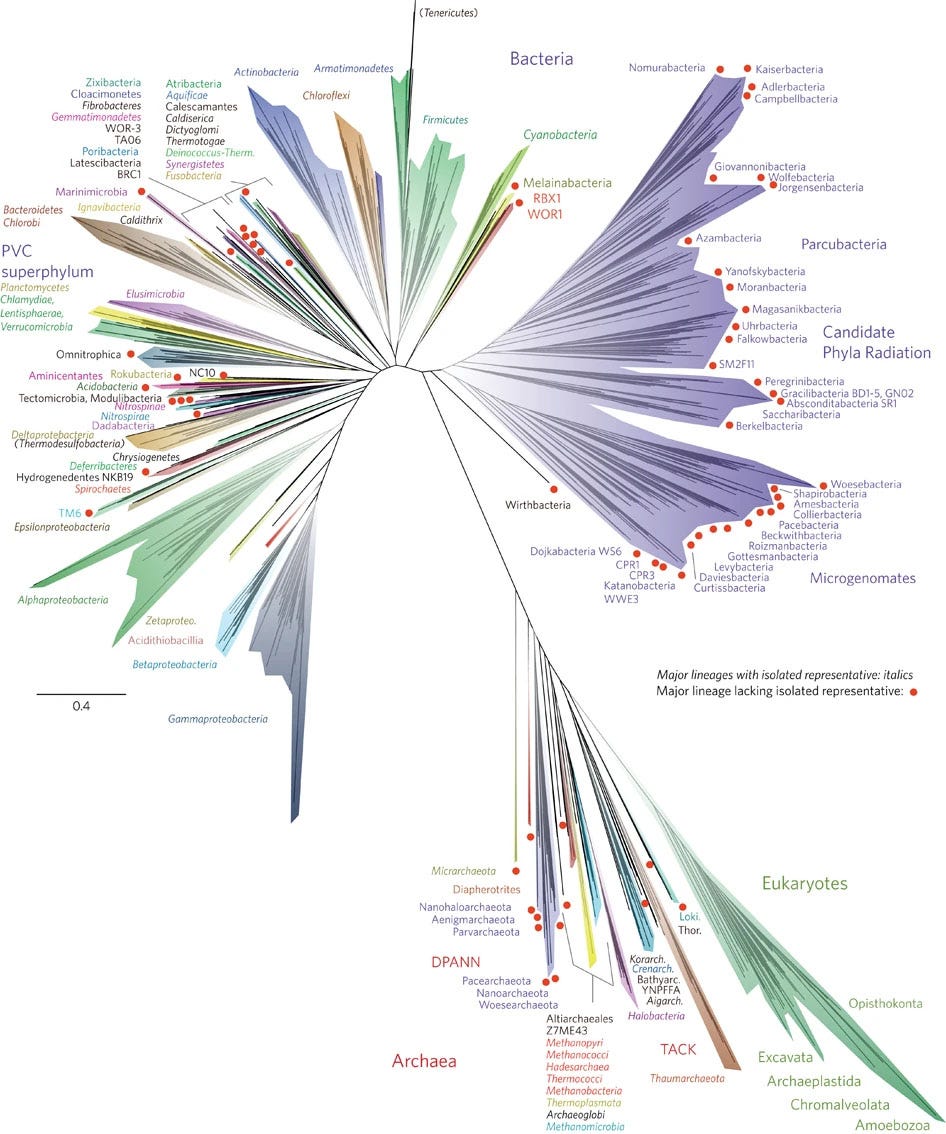
Let’s take a look at recent trees of life. I love the one by Laura Hug and coauthors[v] published in 2016 (Figure 3), because it did a wonderful job of toppling the hierarchical view that puts us multicellular organisms at the top (as in Figure 2). Almost everything in that newer tree is a single-celled prokaryote, either bacteria or archaea, and we eukaryotes only make up a little branch, in green at the lower right. As I said, there is really no bottom or top to this tree, so it is best viewed as lying flat.
The plants are in a little branch called the Archaeplastida supergroup[vi] (no, that is not a rock band composed of famous musicians), and animals are in a branch labeled Ophistokonts together with the fungi. Puts things into perspective, doesn’t it? Much like Copernicus toppled the view that the Earth was the center of the Universe, this tree topples animals, plants, and fungi from the top and shoves us humans into a group with a name that I bet you have never heard before. My fellow Ophistokonts, I salute you!
But let’s look over in Figure 3 at that other branch close to us Ophistokonts, the Archaeplastida, which includes the plants. What all organisms in that group have in common is that they have a certain type of organelle in their cells called a plastid (Archaeplastida means ‘ancient plastids’). These plastids originated from the primary endosymbiosis of a bacterium, and I wrote about that in an earlier post. In plants, these plastids include chloroplasts, which are responsible for photosynthesis. Other organisms have plastids, too, such as the brown algae, but their plastids are different. Brown algae are included in the branch labeled Chromalveolata in the tree in Figure 3.
What became of the plant kingdom? If you compare Figures 2 and 3, it has been demoted and has become invisible, maybe a dukedom at most (no, sadly that is not a taxonomic term). One might say that the barbarians invaded and put an end to the kingdom, much like my barbarian ancestors put an end to the Roman empire. Except that in this case the barbarians are not Visigoths but Archaea and Bacteria. And with the crucial difference that there never really was a plant kingdom; it only existed in our human imagination.
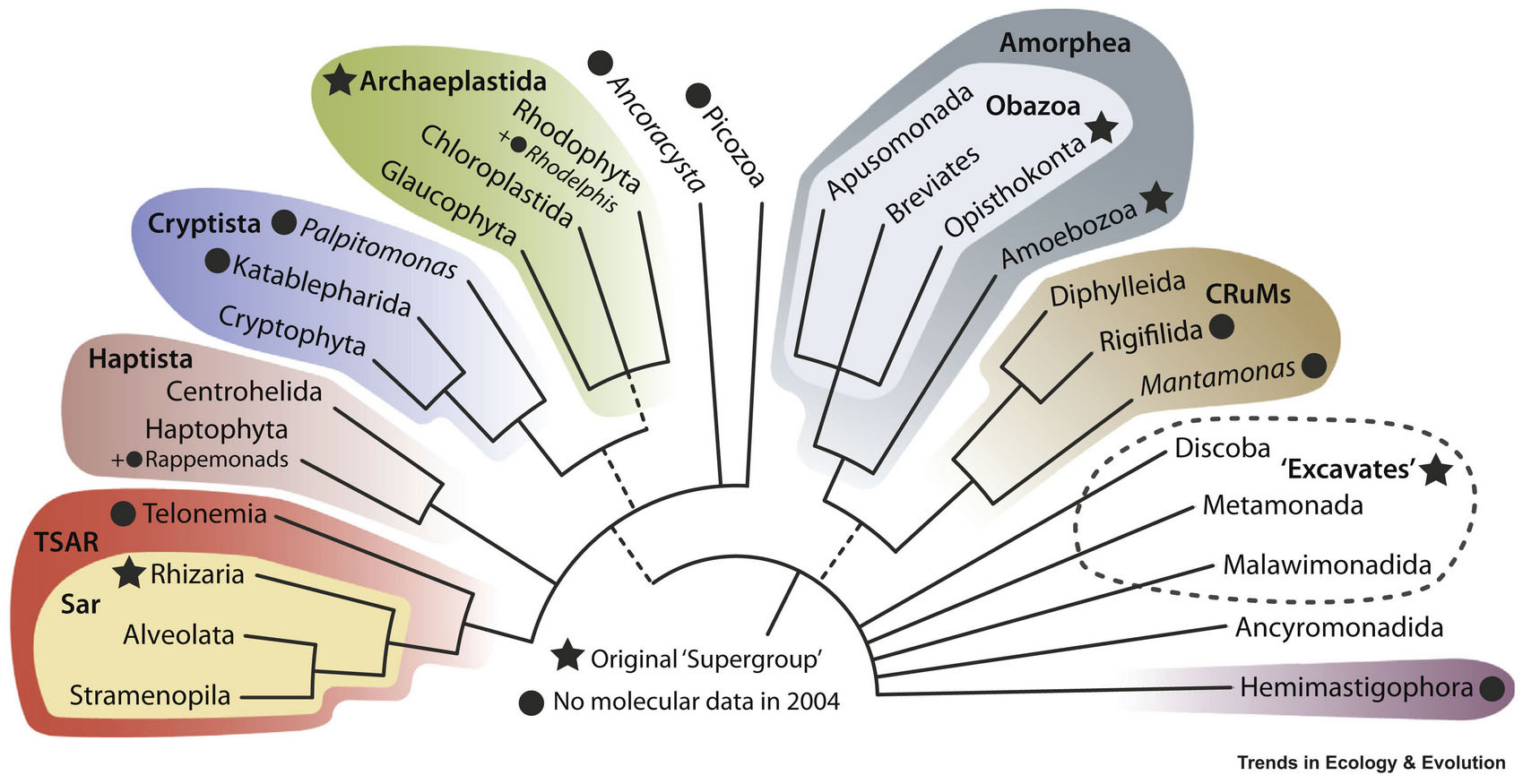
Phylogenetic science moves so rapidly that the tree of life in Figure 3 is already outdated in many details, but its general structure is still valid. Because this is The Plant Connection, let’s take a look at a more recent tree of just the Eukaryotes to see where we now find the plants (Figure 4). This tree from Fabien Burki and coauthors (2020) has plants still in the supergroup Archaeplastida, which includes green plants, here labelled Chloroplastida, red algae, Rhodophyta, and grey algae, Glaucophyta.
What is a plant, anyway?
So, what is a plant? Now that the plant kingdom has been toppled, what even is a plant anymore? I am so sorry to be the bearer of bad news, but there is little agreement among biologists about what a plant is. Some would say a plant is anything in the supergroup Archaeplastida, including red and grey algae. Others would say that only green plants, including green algae are plants; they share the same type of chloroplast with the same pigments and the same type of cell wall made from cellulose. Red and grey algae have different kinds of chloroplasts, they have different pigments, and their cell walls are different, so are they plants? Brown algae are in a different group entirely, in Figure 4 in a supergroup called TSAR.
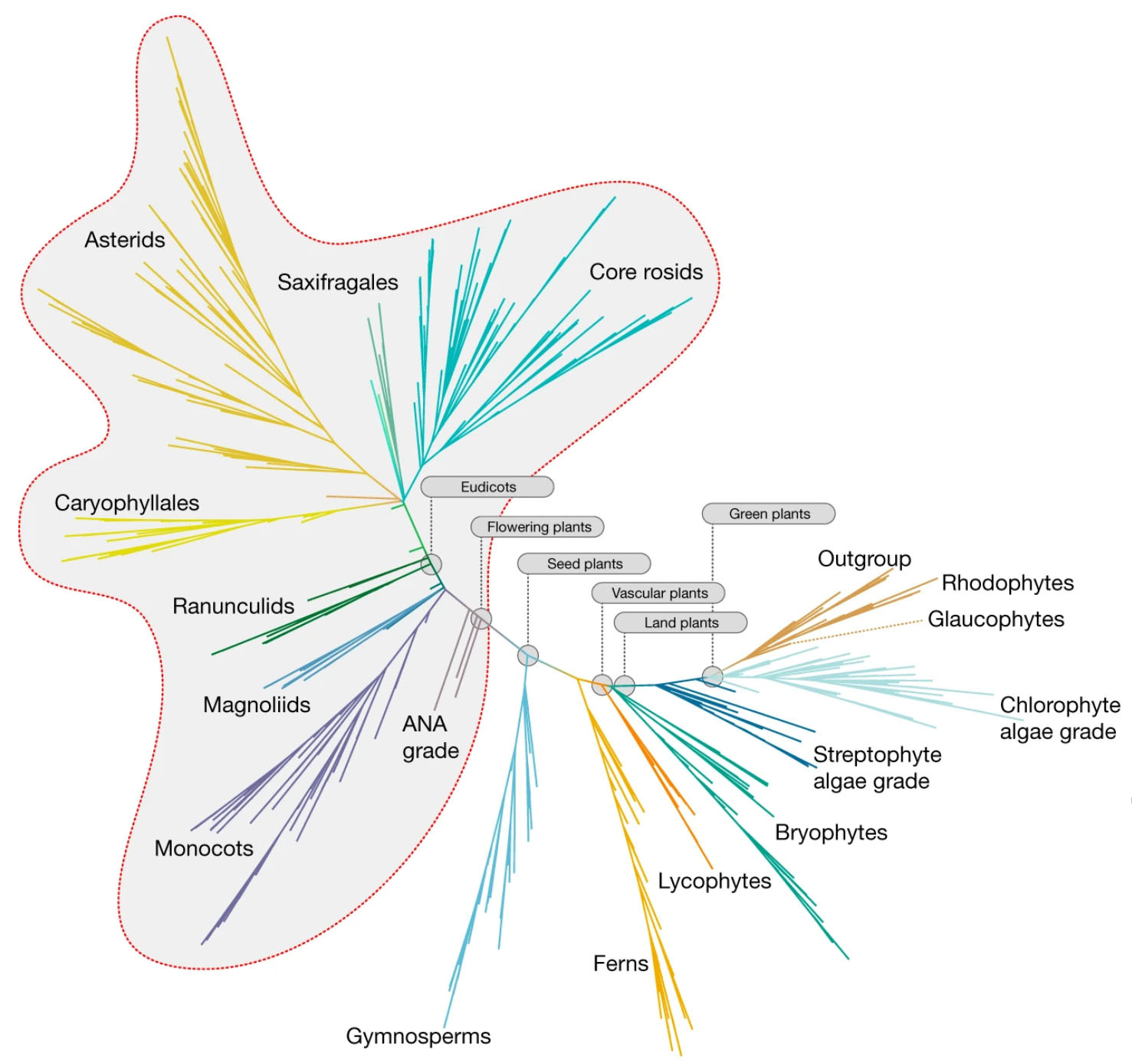
Again, you ask, what is a plant? Can I, as the author of The Plant Connection, not clearly say what kind of organism my Substack is about? Okay, I’ll say it. In my scientific opinion, a plant is an organism that has cell walls made of cellulose, has chloroplasts that resulted from primary endosymbiosis of a cyanobacterium (see my earlier post), and has the pigment chlorophyll B in addition to chlorophyll A. This is the green plants, which also has two scientific names, Chlorophyta and Viridiplantae (take your pick).[vii] You can see this group in the final tree included as Figure 5 from a paper by a scientific collective known informally as the 1KP or formally as the One Thousand Plant Transcriptomes Initiative.[viii] Anything to the left of the label “Green plants” in that tree of the Archaeplastida supergroup to me is a ‘plant’. At least until more evidence emerges or I change my mind.
From one Ophistokont to another, I admit it is confusing that scientific understanding keeps changing, and we can’t be sure anymore what a plant even is. But isn’t it great to live at a time when kingdoms are gone and have been replaced by a tree of life where everyone is equal and just as evolved as everyone else? I think it is wonderful, and I hope that you do, too.
MUSICAL CODA
The king is dead.
[i] Whittaker, R. H. 1969. New concepts of kingdoms of organisms. Science 163:150-160.
[ii] The phrase “self-evident” came from Benjamin Franklin and was intended as a rhetorical device to avoid providing all the reasoning behind the assertion in a short document. There is of course no self-evidence in science. See: Zuckert, M. 1997. The Natural Rights Republic. Notre Dame Press.
[iii] Woese, C. R., and G. E. Fox. 1977. Phylogenetic structure of the prokaryotic domain: The primary kingdoms. Proceedings of the National Academy of Sciences 74:5088-5090.
[iv] Many people find it difficult to interpret phylogenetic trees. Here is a helpful publication from colleagues of mine at Cal State Fullerton that discusses potential pitfalls when interpreting trees and how to do it correctly:: Blacquiere, L. D., and W. J. Hoese. 2016. A valid assessment of students’ skill in determining relationships on evolutionary trees. Evolution: Education and Outreach 9:5. https://link.springer.com/article/10.1186/s12052-016-0056-9#citeas
[v] Hug, L. A., B. J. Baker, K. Anantharaman, C. T. Brown, A. J. Probst, C. J. Castelle, C. N. Butterfield, A. W. Hernsdorf, Y. Amano, K. Ise, Y. Suzuki, N. Dudek, D. A. Relman, K. M. Finstad, R. Amundson, B. C. Thomas, and J. F. Banfield. 2016. A new view of the tree of life. Nature Microbiology 1:16048.
[vi] The old taxonomic categories, such as kingdoms, are replaced in modern trees of life by branches that are called clades. If they are major branches, as in the Archaeplastida, they are called a supergroup.
[vii] Taxonomic debates are really confusing to anyone who is not a taxonomist. The names Viridiplantae and Chlorophyta mean the same thing, or they don’t, depending on how they are defined. Check out this Wikipedia link if you want to know more: https://en.wikipedia.org/wiki/Viridiplantae https://en.wikipedia.org/wiki/Viridiplantae
[viii] One Thousand Plant Transcriptomes, I. 2019. One thousand plant transcriptomes and the phylogenomics of green plants. Nature 574:679-685.
It’s quite fun to start a 1st year UG lecture. “are there any Opisthonkonts in the room?”
I like this post for several reasons. As a plant physiologist, I love that you’ve pointed out that bryophytes and vascular species share a common ancestor. So good! I also really like how well you make the point that all extant species have been evolving for an equal amount of time, i.e, none should be viewed as old dysfunctional relicts, untouched from the consequences of recent selection. I know that when you write, “...everyone is equal and just as evolved as everyone else…”, you are making the point that all extant organisms been subject to natural selection for the same amount of time. However, I wonder if the word “equal” here is being asked to do too much work? Just to add to this thought-provoking sentence, I would like to point out to general readers, some of whom may not be scientists, that this does not mean all organisms, even organisms within species, are equal. They are unequal in almost every meaningful sense of the word… and this is a good thing, not a bad thing. Plants differ in structural complexity, in their ecological functions, in their shape and size, even in the genome size. Just because plants have been subject to natural selection for the same amount of time does not mean that they have changed the same amount, nor in the same way. For example, the “basal” (actually, “sister taxon”) Amborella trichopoda, although exhibiting many similarities with other flowering plant families, has retained many features from its more distant and extinct ancestors. This doesn’t mean that other flowering plants are superior to Amborella, but it certainly does give them a fitness advantage in many important contexts. These differences, especially differences within species, are incredibly important. Mutations and variants arising within populations (differences) are the raw material natural selection acts on, i.e., it is how evolution itself works. If all individuals within a population were identical, natural selection would have no heritable variation upon which to act. So, what I would like to add to this wonderful post is that differences are not bad things. They are good and necessary things – wondrous things. I like to think that Charles Darwin had differences in mind when he wrote, “From so simple a beginning endless forms most beautiful and most wonderful have been, and are being, evolved”.