

Where do plants come from?
A conversation with the poet Lucretius

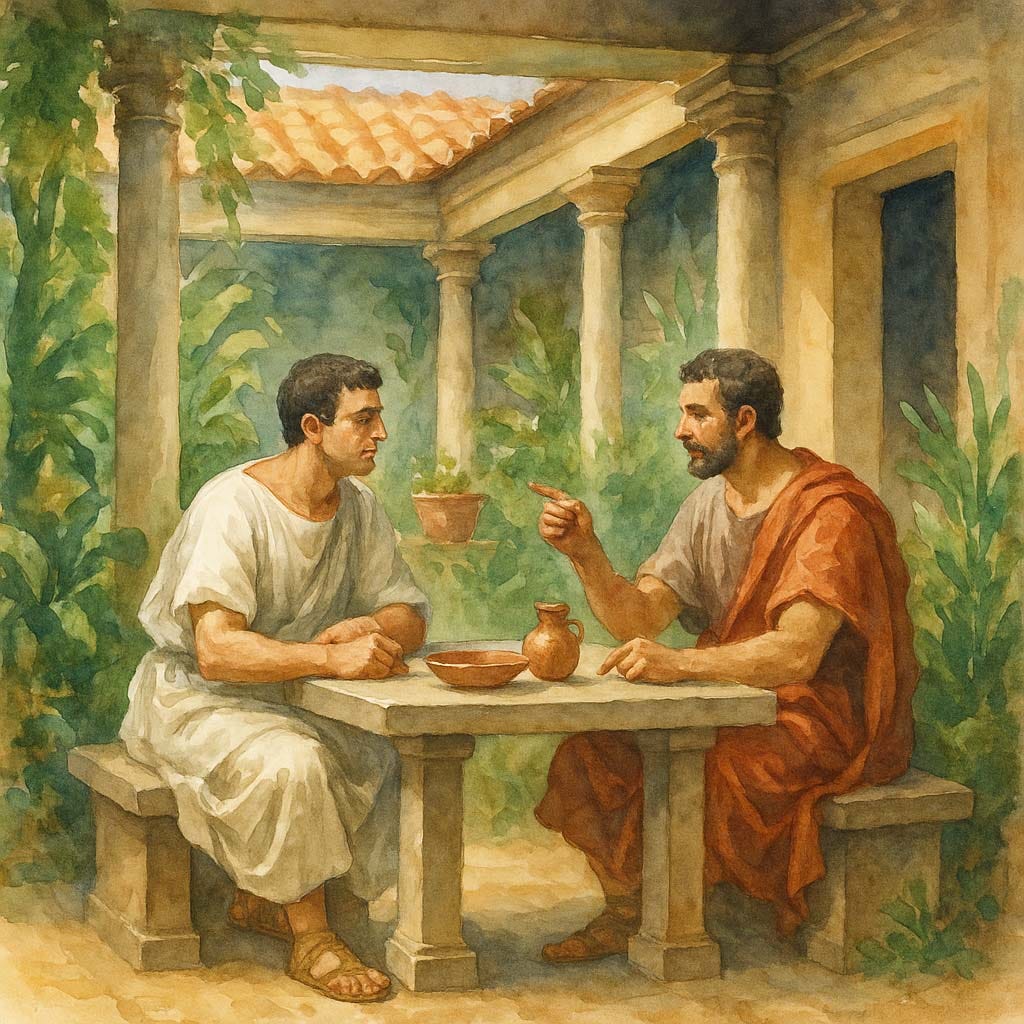
For anyone interested in history, it is convenient to have a time traveler on staff. I am lucky to have one, and I still don’t know how he does it. A magic treehouse? A DeLorean? He won’t say. After talking to Aristotle, my time traveler wanted to find out what the Epicureans thought about plants, where they come from, and what they consist of. The philosopher Epikouros[i] had founded a school in Athens and adopted the idea of atoms from the Presocratic philosopher Demokritos. So what did the Epicureans think about plants? Where do their atoms come from? My time traveler decided to visit a friend, the Roman poet Lucretius[ii], to find out. Here is his report:
After lunch, my friend, the Roman poet Lucretius, and I were sitting in the atrium of Memmius’ house on the outskirts of Rome. Lucretius was staying there while his friend Memmius was out of town. We were lounging beneath a laurel tree on marble benches next to the fountain, surrounded by bushes of cistus, rosemary, and lavender, enjoying Memmius’ Alban wine, and talked about food and atoms, some of Lucretius’ favorite subjects. ‘If food is made of atoms,’ I said, ‘Then that means that the atoms in the artichokes we ate for lunch became part of us.’ ‘Nothing from nothing ever yet was born[iii],’ responded Lucretius, ‘This do I say, as oft I've said before: In earth are atoms of things of every sort; and know, these all thus rise from out the earth, many life-giving which be good for food. Through all our veins disseminates the foods, and gives increase and aliment down to the extreme parts.’ I laughed. ‘Must you always speak in verse?’ ‘I am a poet,’ he said, ‘And those lines are from a poem I am currently working on for Memmius.’ ‘I can’t wait to read that.’ I assured him. ‘But you say that atoms rise out from the earth to become food. If that is so, and if nothing from nothing ever yet was born, shouldn’t there be a hole in the ground under every plant, where the earth atoms turned into plant atoms?’ ‘Perhaps the atoms come from deep down in the earth?’ suggested Lucretius. ‘But, no, there would still be holes under plants.’ ‘Maybe the atoms in the plants come from the air.’ I mused. ‘Epikouros said that air is made of atoms. Why don’t you put that idea into your poem?’ Lucretius laughed. ‘Nobody would believe that, even if it’s true. Let’s leave that for a future poem. And doubtful 'tis what fortune the future times may carry, or what be that chance may bring, or what the issue next awaiting us.’ We left it at that.
Musical Coda
[i] Why do people always latinize Greek names? This philosopher is commonly known as Epicurus, but that wasn’t his name. We would not refer to the Greek king of the gods as Jupiter, so why not use Greek names for other Greeks? It’s a mystery to me.
[ii] Titus Lucretius Carus was an Epicurean poet during the times of Cicero and Julius Ceasar. His writings are the most complete surviving account of Epicurean thought. Check out the great book “The Swerve” by Stephen Greenblatt to learn more about Lucretius and the history of his wonderful poem “De rerum natura”.
[iii] Most of what Lucretius is saying is taken from the translation of Lucretius’ “De rerum natura” (On the nature of things) by William Ellery Leonard. It was amended to fit into a conversation.