

Honest plants
Plants communicate, but are they telling the truth?

“Hey, watch out! There are caterpillars munching my leaves.” That’s what a plant appears to be telling its neighbors. Many books and videos have spread the heartwarming message that plants are caring and kind in their communications to other plants. They warn their plant neighbors about insect attacks, signal each other so they can share resources equitably, and communicate with their seedlings. If only we humans could be so kind to each other!
But wait a minute; is any of this true? We all love to hear about kindness in the natural world, and plants seem to be models of peacefulness and harmony, much more than most animals. Of course we love stories about altruistic plants. But, let’s face it, if somebody tells you exactly what you want to hear and want to believe, isn’t that a good reason to question the information? Could it be that this somebody is trying to sell you a book or maybe something else? Or are they just sharing their genuine enthusiasm about plants? Nothing wrong with that but it does not make a story true. So, let’s take a look at plant communication and see what science can tell us about it.
In this post, I want to talk about honesty in plant communication. A caring and altruistic plant surely would never lie! I cannot reasonably assume that my readers read any of my previous posts or remember what was in them, so here is a quick refresher about plant communication and what it is. If you like, check out the previous posts on the subject, Rose hips in winter and Do plants communicate?
As I wrote previously, communication is a process by which a signaler benefits from an information exchange with a receiver through a common system of signals.[i] The key for signaling being real communication is that the signaler benefits, while the receiver may or may not. In biology, that benefit means to improve its chances to have more offspring and spread its genes to the next generation, what we call biological fitness. For humans, benefits can take other forms, such as power, wealth, or fame. Plants may be able to become powerful competitors and take over an entire area, as kudzu vines do. They can accumulate a wealth of resources, such as a giant sequoia tree does in its trunk. But that all can be measured in plants as an increase in fitness, producing more seeds and more successful seedlings, and passing genes on to future generations.
Comparing plants with humans in this case is helpful, because we can see immediately that humans can reap great benefits by lying and cheating. Current government officials and billionaire oligarchs come to mind as prime examples. So why shouldn’t something similar be true for plants? Could they benefit from sending dishonest signals into the world, lying and cheating? Let’s have some examples.
Plant signaling to their neighbors
A plant could send a chemical signal from its roots that tells other plant roots to stay away. That signal effectively says “I am a big and powerful plant and a superior competitor. In your own interest, do not invade my space, because you are going to lose the competition with me.” This is not a hypothetical example. Creosote bushes that cover vast amounts of the deserts in North America were among the first plants identified to send chemical signals from their roots, and the message I described is what they were thought to be ‘saying’ to other plants.[ii]
If that message is true then it could benefit other plants to keep their roots away from the creosote bush. But what if the creosote bush were lying? It sends a signal, but it is not a powerful competitor at all, just pretending to be one? In that case it would be pretty stupid for other plants to believe the message and restrict their own roots from growing into soil that could contain a lot of water and nutrients. Those other plants could lose fitness by ‘believing’ the lies. How can they know if the message is true?
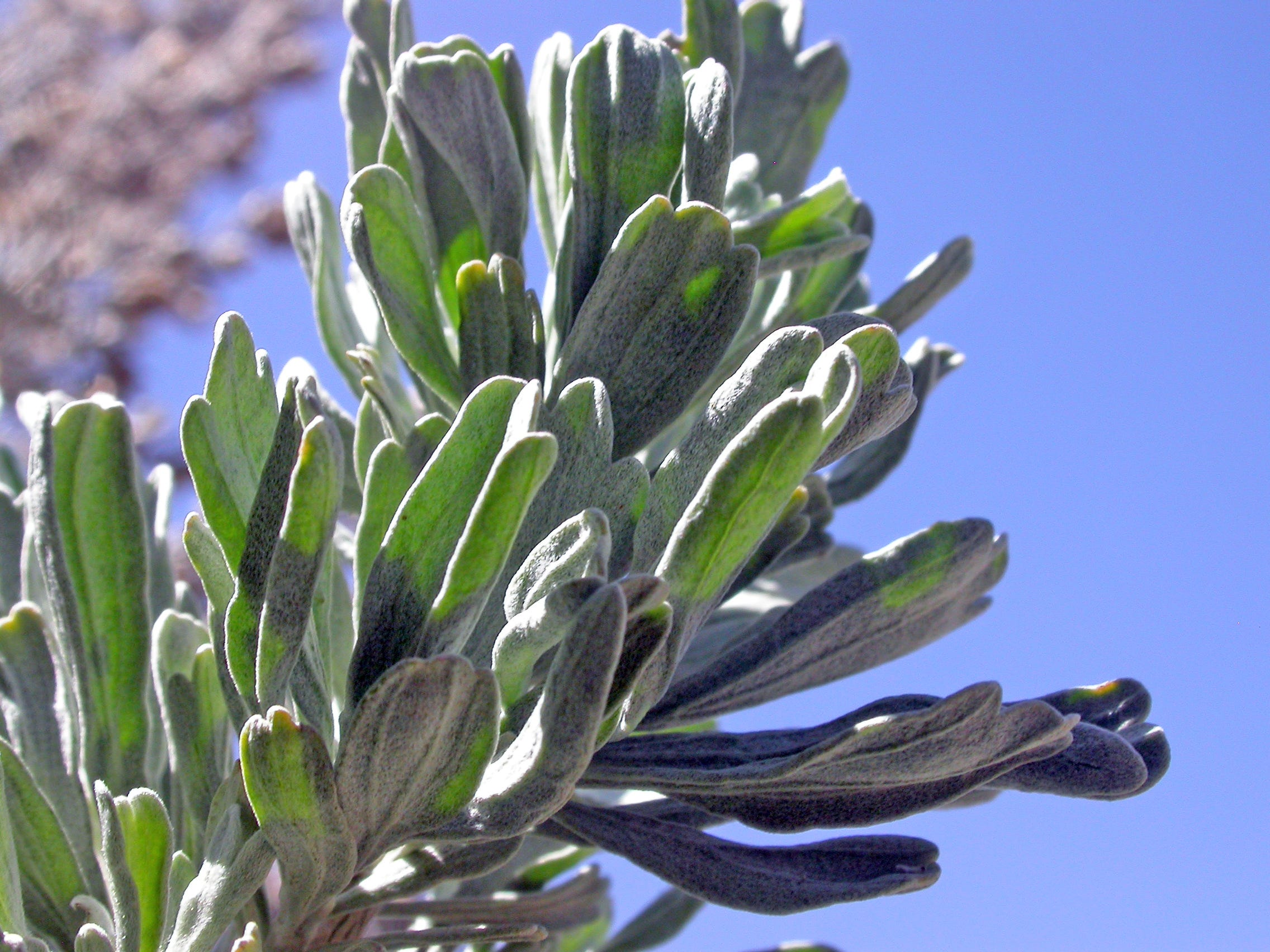
Plants that warn their neighbors about insect attacks is another popular example. Many plants send volatile chemical signals when an herbivore chews on their leaves. Poplars, willows, maples, sagebrush (Fig. 1), goldenrod, wild tobacco, mulefat, and many more are known to do this.[iii] These signals quickly warn other parts on the same plants to get their chemical defenses ready or grow stronger cell walls, even make thorns. Many acacias can do the latter after being munched on, for example by giraffes. The plant uses volatile chemicals to communicate quickly with all its parts and clearly benefits itself from doing that. The volatile signals also reach neighboring plants and warn them to get their defenses ready.
Are plants sending honest signals?
But why would a plant warn its neighbors? How would it benefit from that? Are the neighbors just eavesdropping as the plant ‘talks’ to itself? Consider that defenses are costly. It takes resources to make defensive chemicals, tougher cell walls, or thorns. A clever plant could mislead its neighbors by sending false messages about being attacked, fooling its neighbors into using valuable resources for defense against imaginary herbivores instead of competing with their dishonest plant neighbor.
These examples may sound unlikely, but could you confidently say that plants would never do such things? Why wouldn’t they if they could benefit from being dishonest? The same question has been asked about humans at least since the days of the Greek philosopher Plato. How can other plants decide if they are being lied to?
So, what about plants warning their neighbors about insect attack? Can neighbors trust that message? Not necessarily, but the idea that a sagebrush plant could have a consistent fitness benefit from fooling its sagebrush neighbors into investing in defenses is unlikely to be true. For such false messaging behavior to evolve by natural selection, the plants sending the signals would have to have a significant fitness advantage. Let’s play the evolution game and assume that the plant doing that has a lot of seedlings that also send out false messages. After some generations, this sagebrush population would consist of plants that are all sending meaningless signals to each other, and the fitness advantage would go away.
What about other plant species growing nearby, could they be fooled by false volatile signals? Yes, that is possible, but their populations are also evolving, and plants that ignore those false messages would reproduce more, have more seedlings, and eventually there would be no plants left that react to these false messages. So, lying to your neighbors may be good for a short while but is not an evolutionary stable strategy in the long run. The other example of the root signals that say “I am big and strong; stay away from me!” leads to similar conclusions. If that message is usually false, then neighboring plants will eventually ‘learn’ to ignore it. The difference between the two examples is that volatile alarm calls can benefit both the signaling plants and the receivers, while the root signal is an example where two plants have mostly competing interests.
Truth and lie: How to tell the difference
Wouldn’t it be helpful if plants could just tell the difference between truth and lies? If they could recognize a true alarm call then they would benefit by getting their defenses ready. If they could sense that a strong competitor is nearby then they could send their roots elsewhere and benefit that way. If they could recognize a lie then they could ignore it. How could a plant ever tell that difference? How can an animal or a human tell if they are being lied to?
Imagine, if you can, an inveterate liar. Let’s take a politician who is lying so much all the time that it is impossible say when he is ever telling the truth. Is someone coming to mind? Good! Now, what message would you believe from that politician? Your first answer may be “Nothing!”, but is that true? What if that politician admitted to something that is not in his interest. Let’s say it is something that will not get him reelected, may get him impeached, or potentially thrown into prison. Would you believe that admission? You probably would, because it is not in that man’s best interest. It is a costly admission. And the high cost involved makes it believable.
The idea that honest communication must be costly is known as the handicap principle. It was first proposed for communication in animals by the zoologist Amotz Zahavi in 1975, who later wrote a fascinating book about it.[iv] But the idea that honest communication must be costly goes way back to earlier philosophers. Thomas Hobbes in his book Leviathan (1651), argued that promises and assertions are not inherently trustworthy. A king or a government can impose penalties and costs on lying, for example in a court proceeding, making it more likely for someone to tell the truth. David Hume in the 18th Century argued that honesty is costly. Someone who is always honest won’t have all the advantages of little lies and deceptions here and there and will gain trust from others because that individual has the reputation that they are willing to accept those honesty costs.[v]
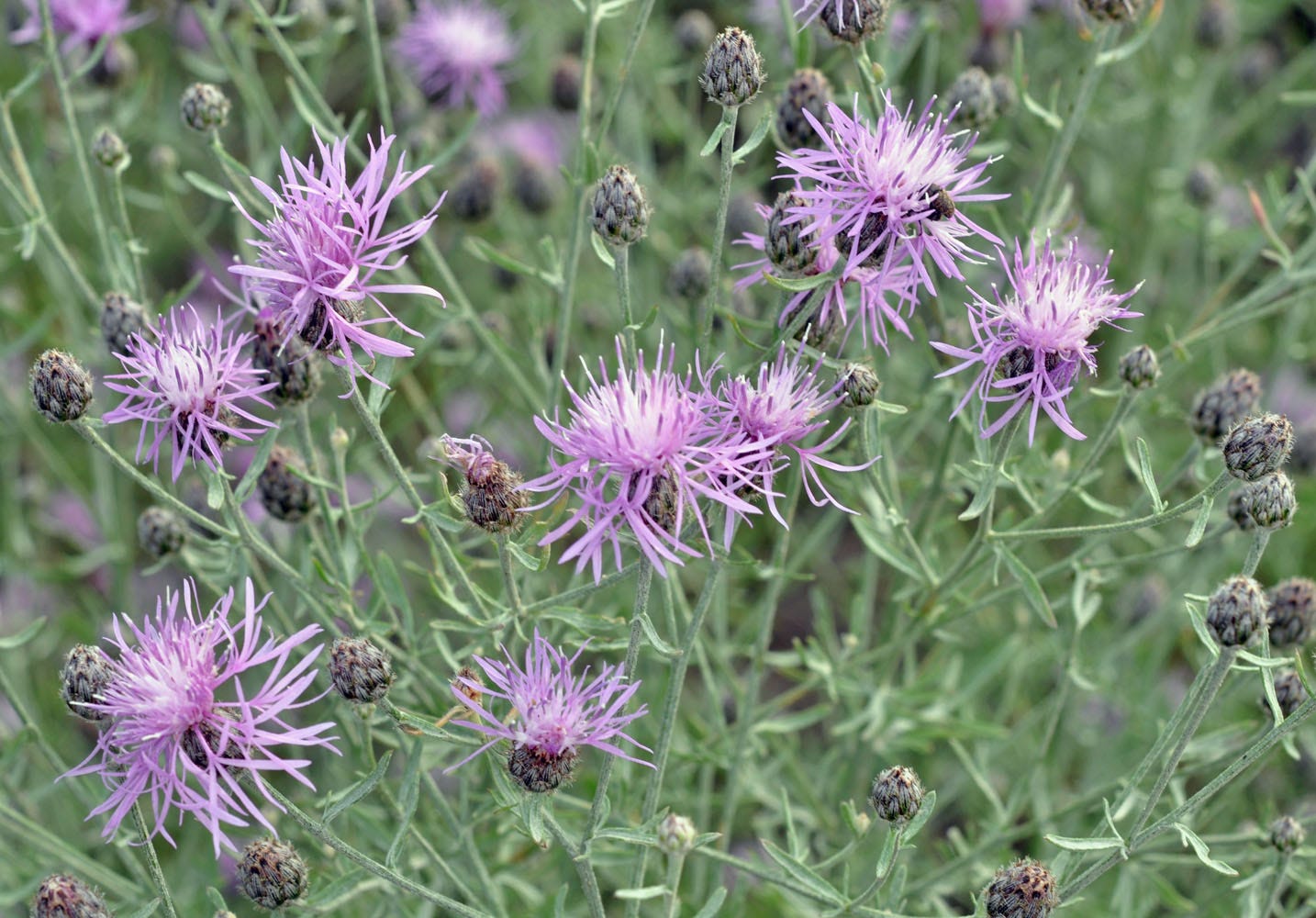
How does this apply to plants? What kind of communication could be costly? My coauthor Eric Seabloom and I were the first to apply the handicap principle to communication in plants[vi], and we proposed that costly signals could be chemicals that are costly to produce, for example by producing a large amount of volatiles. As another example, toxic substances are costly to make, because the plant making them must protect itself against the substances. A great example for this is the Asian plant spotted knapweed, Centaurea stoebe, an invasive weed in North America (Fig. 2). This species makes a root toxin known as (±)-catechin, which was found to poison roots of its competitors in North America.
You may object that poisoning is not communication but hear me out. Spotted knapweed also makes (±)-catechin in its native habitat in Asia, but the plant species that grow with it there have co-evolved with it to tolerate the toxin.[vii] Spotted knapweed in Asia still makes this stuff, but it appears to function as a signal now and no longer as a poison. In contrast, when spotted knapweed first arrived in North America, the plants there had no tolerance to (±)-catechin, and spotted knapweed became a huge problem, invading large parts of the Great Basin and replacing native plants. But the North American plants are catching on and are also evolving tolerance to the toxin, an example for natural selection in action.[viii] The toxin appears to become a costly signal that tells other plants that a strong competitor is nearby.
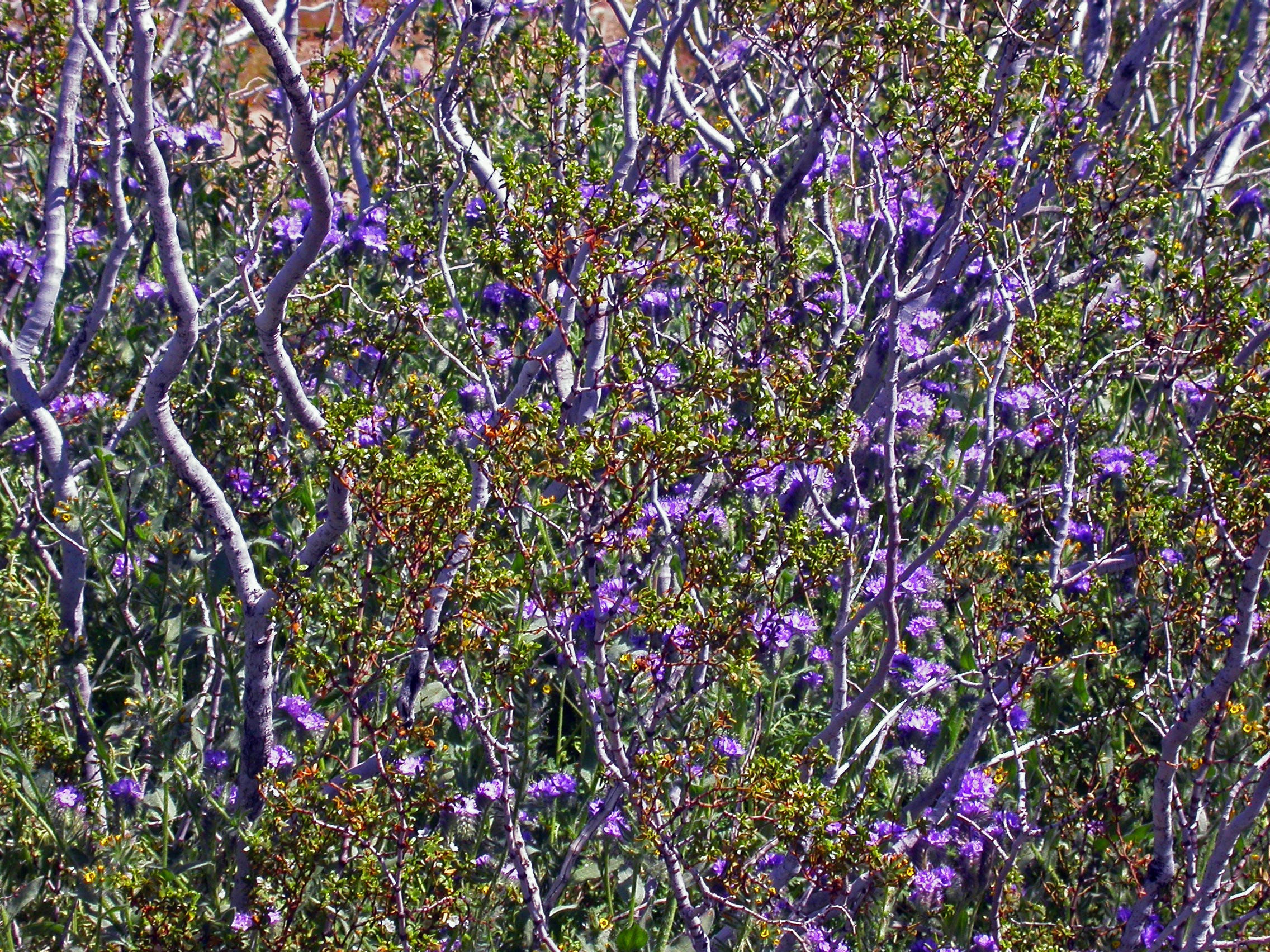
This is not unlike a songbird marking its territory by spending a lot of time singing. That is also a costly signal, because the bird is singing instead of foraging for food, and it is exposing itself to predators. Just like territorial songbirds, plants are also using costly signals to mark root territories, like the knapweed and the creosote bush mentioned in the beginning.[ix] Neighbors can ignore these signals (Fig. 3) but may benefit from avoiding a fight and instead get their resources elsewhere.
So, what about those kind and caring plants that send warnings to their friends? It turns out that they are doing it for themselves. And the friends are in on the game for their own benefit. That’s how plant communication could evolve by natural selection. The sender benefits and sometimes the receiver does, too. It usually turns out that way when you look closely at stories about plants caring for their seedlings, relatives, and neighbors. Sometimes those seedlings, relatives, and neighbors really benefit, but the whole system works for the advantage of the plant sending the signal. If you want to read stories about caring and altruistic organisms, then you’d better look for stories about social animals. Even we humans could teach the plants a thing or two about altruism. Imagine that!
MUSICAL CODA
[i] There have been many attempts to define biological communication. I discussed them and arrived at this consensus definition in this book chapter: Schenk, H. J., and E. W. Seabloom. 2010. Evolutionary ecology of plant signals and toxins: a conceptual framework. Pages 1-19 in V. Ninkovic and F. Baluška, editors. Plant communication from an ecological perspective. Springer-Verlag, Berlin. Unfortunately not open access. Let me know if you want to get a pdf.
[ii] Mahall, B. E., and R. M. Callaway. 1991. Root communication among desert shrubs. Proceedings of the National Academy of Sciences (USA) 88:874-876.
[iii] Rhoades, D. F. 1983. Responses of alder and willow to attack by tent caterpillars and webworms: Evidence for pheromonal sensitivity of willows. Pages 55-68 in Plant Resistance to Insects. American Chemical Society. Baldwin, I. T., and J. C. Schultz. 1983. Rapid changes in tree leaf chemistry induced by damage: evidence for communication between plants. Science 221:277-279. Kalske, A., K. Shiojiri, A. Uesugi, Y. Sakata, K. Morrell, and A. Kessler. 2019. Insect herbivory selects for volatile-mediated plant-plant communication. Current Biology 29:3128-3133.e3123. Moreira, X., C. S. Nell, M. M. Meza-Lopez, S. Rasmann, and K. A. Mooney. 2018. Specificity of plant–plant communication for Baccharis salicifolia sexes but not genotypes. Ecology 99:2731-2739.
[iv] Zahavi, A., and A. Zahavi. 1997. The handicap principle: a missing piece of Darwin’s puzzle. Oxford University Press, New York, Oxford.
[v] David Hume, 1739. A treatise of human nature. Volume 3, Section 2.
[vi] Schenk, H. J., and E. W. Seabloom. 2010. Evolutionary ecology of plant signals and toxins: a conceptual framework. Pages 1-19 in V. Ninkovic and F. Baluška, editors. Plant communication from an ecological perspective. Springer-Verlag, Berlin.
The handicap principle states that honest communication requires costly signals. That is a broad generalization and not a testable scientific hypothesis. To be a hypothesis, it would have to be much more specific and the meaning of ‘costly’ must be defined. Costly relative to what? A million dollar is costly to a normal person, but not to a billionaire. In 2020, a publication by Penn and Számadó attacked the handicap principle by claiming it was a hypothesis, which they then proceeded to refute and replace with their own. This was a classic strawman argument, because a general principle is not a hypothesis. The authors proposed that the costs are relative to other costs and benefits, so-called tradeoffs. Relative costs are still costs, and the principle holds. Here is the citation: Penn, D. J., and S. Számadó. 2020. The Handicap Principle: how an erroneous hypothesis became a scientific principle. Biological Reviews 95:267-290.
[vii] Bais, H. P., R. Vepachedu, S. Gilroy, R. M. Callaway, and J. M. Vivanco. 2003. Allelopathy and exotic plant invasion: From molecules and genes to species interactions. Science 301:1377-1380.
[viii] Callaway, R. M., W. M. Ridenour, T. Laboski, T. Weir, and J. M. Vivanco. 2005. Natural selection for resistance to the allelopathic effects of invasive plants. Journal of Ecology 93:576-583.
[ix] Schenk, H. J., R. M. Callaway, and B. E. Mahall. 1999. Spatial root segregation: Are plants territorial? Advances in Ecological Research 28:145-180.
Great post